Introduction:
Understanding Solar Leasing
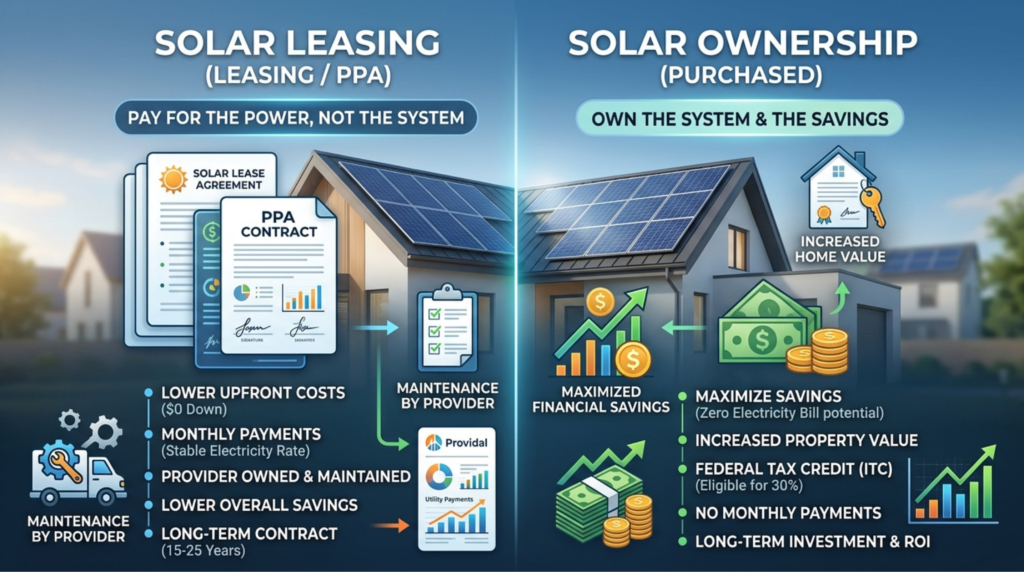
Solar leasing allows you to install a solar system without paying the full upfront cost. Instead, you pay a fixed monthly fee to use the system.
How Solar Leasing Works:
- A third-party company installs and owns the system
- You pay a monthly lease or power purchase agreement (PPA) fee
- Maintenance and servicing are usually included
- Savings come from reduced electricity bills
Key Advantages of Solar Leasing:
- No or low upfront investment
- Predictable monthly payments
- Maintenance handled by provider
- Quick adoption without financial burden
Limitations of Solar Leasing:
- Lower long-term savings compared to ownership
- No ownership of the asset
- Limited eligibility for tax benefits
Understanding Solar Ownership
Solar ownership involves purchasing the solar system outright or through financing options such as loans.
How Solar Ownership Works:
- You invest in purchasing the solar system
- You own the asset and generate your own electricity
- You benefit from government incentives and tax savings
- Maintenance is your responsibility (or managed via AMC contracts)
Challenges of Solar Ownership:
- Higher initial investment
- Responsibility for maintenance
- Longer decision-making process
RVK Solar Advantage:
We provide end-to-end ownership solutions, including financing assistance, installation, and maintenance services, ensuring maximum ROI and hassle-free operation.
Solar Leasing vs Solar Ownership: Key Differences
Understanding solar leasing vs solar ownership requires a clear comparison across critical factors.
1. Cost Comparison
- Leasing: Low upfront cost, ongoing monthly payments
- Ownership: High initial investment, long-term savings
2. Return on Investment
- Leasing: Moderate savings over time
- Ownership: Higher ROI and faster payback period
3. Maintenance Responsibility
- Leasing: Managed by provider
- Ownership: Managed by owner or service provider
4. Financial Benefits
- Leasing: Limited tax benefits
- Ownership: Full access to incentives and depreciation benefits
5. Flexibility
- Leasing: Less flexibility due to contracts
- Ownership: Full control and scalability
Which Option is Better for Businesses?
The answer depends on your financial goals, operational scale, and long-term strategy.
Choose Solar Leasing If:
- You want minimal upfront investment
- You prefer predictable expenses
- You want a hassle-free solution
Choose Solar Ownership If:
- You aim for maximum long-term savings
- You want full control over your energy
- You are ready for upfront investment
Decision Checklist:
- Budget availability
- Energy consumption level
- ROI expectations
- Business expansion plans
Financial Analysis: Leasing vs Ownership
A deeper financial comparison highlights the real difference.
Leasing Financial Snapshot:
- Lower initial cost
- Fixed monthly payments
- Gradual savings
Ownership Financial Snapshot:
- Higher upfront cost
- Rapid cost recovery (3–5 years)
- Long-term free electricity
Key Insight:
Over a 20–25 year lifespan, ownership typically delivers significantly higher savings compared to leasing.
Long-Term Impact on Business Growth
Choosing between solar leasing vs solar ownership is not just about cost—it’s about long-term business strategy.
Business Benefits of Solar Adoption:
- Reduced operational expenses
- Improved sustainability credentials
- Enhanced brand reputation
- Energy independence
Strategic Value:
- Protects against rising electricity prices
- Supports ESG and compliance goals
- Increases property value
Why Choose RVK Solar?
Choosing the right solar partner is just as important as choosing the right solar solution, and RVK Solar stands out as a trusted name in delivering reliable, high-performance solar systems tailored to diverse business and residential needs. With a strong focus on quality, innovation, and customer satisfaction, RVK Solar provides end-to-end services—from detailed site analysis and customized system design to seamless installation and ongoing maintenance support. Our team of experts ensures that every project is optimized for maximum efficiency, long-term durability, and the highest possible return on investment. We prioritize transparency, offering clear cost structures and accurate performance projections so you can make confident decisions. Whether you are opting for solar leasing or ownership, RVK Solar delivers scalable, future-ready solutions that align with your energy goals while helping you reduce costs, enhance sustainability, and achieve energy independence.
Our Key Strengths:
- Customized leasing and ownership solutions
- Advanced solar technology and premium components
- Expert installation and maintenance support
- Transparent pricing and ROI clarity
- Proven experience across industries
Explore our services:
RVK Solar Official Website
Search us on Google:
Find RVK Solar on Google
Conclusion:
When comparing solar leasing vs solar ownership, the right choice ultimately depends on your financial capacity, business goals, and long-term vision. Leasing offers a low-risk entry into solar energy, while ownership delivers maximum savings and control over time. For businesses aiming for long-term growth, sustainability, and cost efficiency, solar ownership often emerges as the superior choice. However, leasing remains an excellent option for those seeking flexibility and minimal upfront investment. At RVK Solar, we help you evaluate both options and implement the most effective solar strategy tailored to your needs. Choosing between solar leasing vs solar ownership ultimately comes down to your financial priorities, risk tolerance, and long-term vision. Leasing is an excellent option for those seeking a low-commitment, hassle-free way to adopt solar energy, while ownership stands out as the most rewarding choice for those focused on maximizing returns and achieving true energy independence. Both options have their advantages, but the right decision lies in aligning your energy solution with your business or personal goals. As solar technology continues to advance and energy costs keep rising, investing in solar is no longer optional—it’s a strategic necessity. At RVK Solar, we are committed to helping you make the right choice with confidence, offering expert guidance, customized solutions, and long-term support. Now is the time to take control of your energy future—partner with RVK Solar and move toward a smarter, more sustainable tomorrow.
FAQs:
1. What is the main difference between solar leasing and ownership?
Leasing involves paying a monthly fee, while ownership means buying and owning the system outright.
2. Which option offers better savings?
Solar ownership typically offers higher long-term savings compared to leasing.
3. Is solar leasing risk-free?
It has lower financial risk but offers limited long-term benefits.
4. Can businesses switch from leasing to ownership later?
In some cases, yes—depending on contract terms.
5. How long does it take to recover solar investment?
For ownership, the payback period is usually 3–5 years.