Rooftop Solar System for Home: Cost, Subsidy and Savings Explained
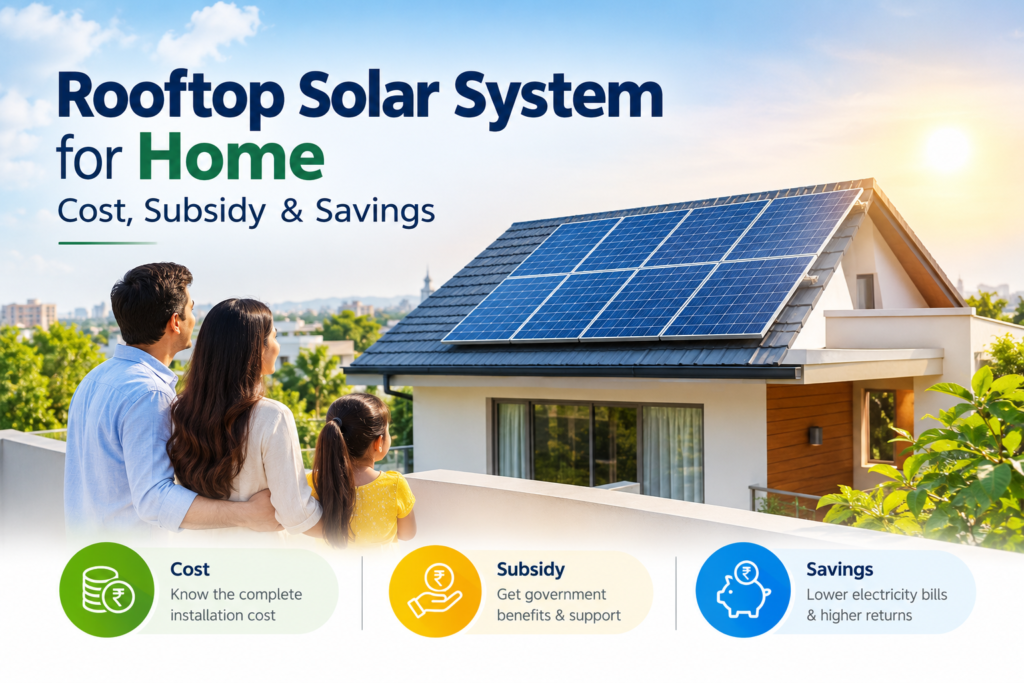
A rooftop solar system for home use turns your unused terrace into a small power plant that works for you every sunny day. Instead of paying the electricity company for every unit, you generate a large share of your own power, send the surplus back to the grid and watch your monthly bill shrink. For many Indian families, a rooftop solar system for home is now one of the few investments that cuts a recurring expense and pays for itself within a few years.
In this guide, RVK Solar explains what a home solar plant really costs, how the PM Surya Ghar subsidy works, how to choose the right capacity, and what happens from the first site visit to the day your system switches on.
How Much Does a Rooftop Solar System for Home Cost?
The price of a rooftop solar system for home use depends on capacity, panel brand, inverter quality, mounting structure, roof type and your location. Because equipment and labour rates vary, the only reliable figure is a written quote after a site survey. What you can do beforehand is understand the cost drivers:
- System size in kW: A larger plant costs more in total but usually less per kW.
- Panel technology: Mono PERC and TOPCon panels cost more than older modules but produce more power from the same roof area.
- Inverter and monitoring: A reliable inverter with app-based monitoring is worth paying for, since it is the part most likely to need attention over the years.
- Structure and wiring: Hot-dip galvanised structures, proper cabling and earthing protect your investment against wind, rain and surges.
- Net metering and approvals: Paperwork and meter charges differ between DISCOMs.
Here is an indicative guide to what different home system sizes can generate and what central subsidy they attract:
| System Size | Approx. Daily Generation | Approx. Monthly Generation | Central Subsidy |
|---|
| 1 kW | 4 units | 120 units | ₹30,000 |
| 2 kW | 8 units | 240 units | ₹60,000 |
| 3 kW | 12 units | 360 units | ₹78,000 |
| 5 kW | 20 units | 600 units | ₹78,000 (capped) |
Generation figures are estimates for typical sunny conditions in India and will vary with location, season and shading.
PM Surya Ghar Subsidy: What You Can Actually Claim
The PM Surya Ghar: Muft Bijli Yojana is a central government scheme that supports residential rooftop solar. Under the nationally published structure, the subsidy is ₹30,000 per kW for the first 2 kW and ₹18,000 for the third kW, which means a ceiling of ₹78,000 for systems of 3 kW and above. So a 1 kW plant attracts ₹30,000, a 2 kW plant attracts ₹60,000, and a 3 kW or larger plant attracts ₹78,000.
A few points are worth remembering before you plan your rooftop solar system for home:
- The subsidy applies to grid-connected systems on residential connections only, not to commercial or industrial ones.
- Going beyond 3 kW does not increase the central subsidy, so every extra kW is self-funded.
- You need a shadow-free roof and should not have claimed a central solar subsidy earlier at the same address.
- Several states add their own incentives on top, so check what your state offers.
- Applications are made through the official portal at pmsuryaghar.gov.in, and the subsidy is released after the plant is installed, inspected and commissioned.
For policy updates and scheme details, the Ministry of New and Renewable Energy is the authoritative source, since rules and amounts can change.
Picking the Right Capacity for Your Household
The simplest way to size a rooftop solar system for home use is to look at your last six to twelve electricity bills. Find your average monthly units, then divide by roughly 120, because a 1 kW plant typically generates about that many units a month. A household using 300 units a month, for example, is a good fit for a 2.5 to 3 kW system.
Space matters too. As a rule of thumb, every kW needs around 80 to 100 square feet of clear, shadow-free area. Terraces with water tanks, staircase rooms or tall neighbouring buildings may need a layout that avoids shading, and this is where a proper survey saves you from an under-performing plant.
What Decides How Much Power Your Panels Produce
Two homes with the same system size can generate different amounts of power. The common reasons are:
- Direction and tilt: South-facing panels at an angle close to your city’s latitude usually perform best in India.
- Shading: Even a small shadow on one panel can pull down the output of a whole string.
- Dust and bird droppings: A dirty surface blocks sunlight and quietly reduces generation.
- Heat: Panels lose a little efficiency on very hot days, so good ventilation under the modules helps.
- Inverter quality: An efficient inverter wastes less of the power your panels create.
Looking After Your Panels Over the Years
A rooftop solar system for home use is low-maintenance, not no-maintenance. Rinse the panels with plain water every two to three weeks, preferably early in the morning, and avoid harsh chemicals or abrasive tools. Check your monitoring app for sudden drops in generation, and arrange an annual inspection of connections, structure and earthing. Inverters typically need replacement somewhere around the ten-year mark, which is worth keeping in mind when you calculate lifetime savings.
Why Families Trust RVK Solar
Going solar is a long-term decision, so the team behind your plant matters as much as the panels. RVK Solar works with residential, commercial and industrial customers and looks after the full journey, from consultation and system design to installation and ongoing maintenance.
- Honest sizing: The recommendation is based on your actual bills and roof, not on selling the biggest system.
- Clear quotation: You see what is included, from panels and inverter to structure, wiring and approvals.
- Paperwork support: Registration, net metering and subsidy steps are handled alongside the installation.
- After-sales care: Maintenance support keeps your plant generating at its best.
You can learn more about the company on the about page or see the full range of solar installation services.
Ready to Cut Your Bill? Talk to RVK Solar
If you have been thinking about a rooftop solar system for home use, the best next step is a free conversation about your roof and your electricity bills. Contact RVK Solar to book a site survey, get a capacity recommendation and receive a clear quote with the subsidy worked out for you.
Light Up Your Home With Solar
Ready to bring a rooftop solar system for home use to your terrace? Contact RVK Solar at H.no.1, Semar Wali Gali, Mill Road, Ganj Basoda, Dist: Vidisha (M.P.) – 464221, and get a roof survey, the right capacity for your bills and a clear quote with the PM Surya Ghar subsidy worked out.
or reach out via our Contact Us page for a free site visit.
Call us: +91 98273 73375 | Email: rvksolar@gmail.com
FAQs:
1. How much can a rooftop solar system for home save on electricity bills?
Savings depend on system size and your usage pattern. A plant sized to your daytime consumption can offset a large part of your bill, and units you export through net metering are credited against what you draw from the grid. Your fixed charges and any night-time consumption will still appear on the bill.
2. What is the payback period of a home solar plant?
Many households see payback in roughly four to six years once the subsidy is included, though this varies with your tariff, usage and system cost. After that, most of the electricity your panels generate is effectively free for the rest of their life.
3. Will my rooftop solar system work during a power cut?
A standard on-grid system shuts down during a grid outage for safety reasons. If you want backup power, you need a hybrid system with batteries, which costs more but keeps selected appliances running.
4. Is the subsidy available for every home?
The central subsidy covers grid-connected systems on residential connections and requires a suitable shadow-free roof. Capacity above 3 kW does not increase the central amount, and state schemes differ, so confirm your eligibility on the official portal before you commit.
5. How long do solar panels last?
Quality panels commonly carry a performance warranty of about 25 years and continue producing for a long time after that, with a slow, gradual decline in output each year.